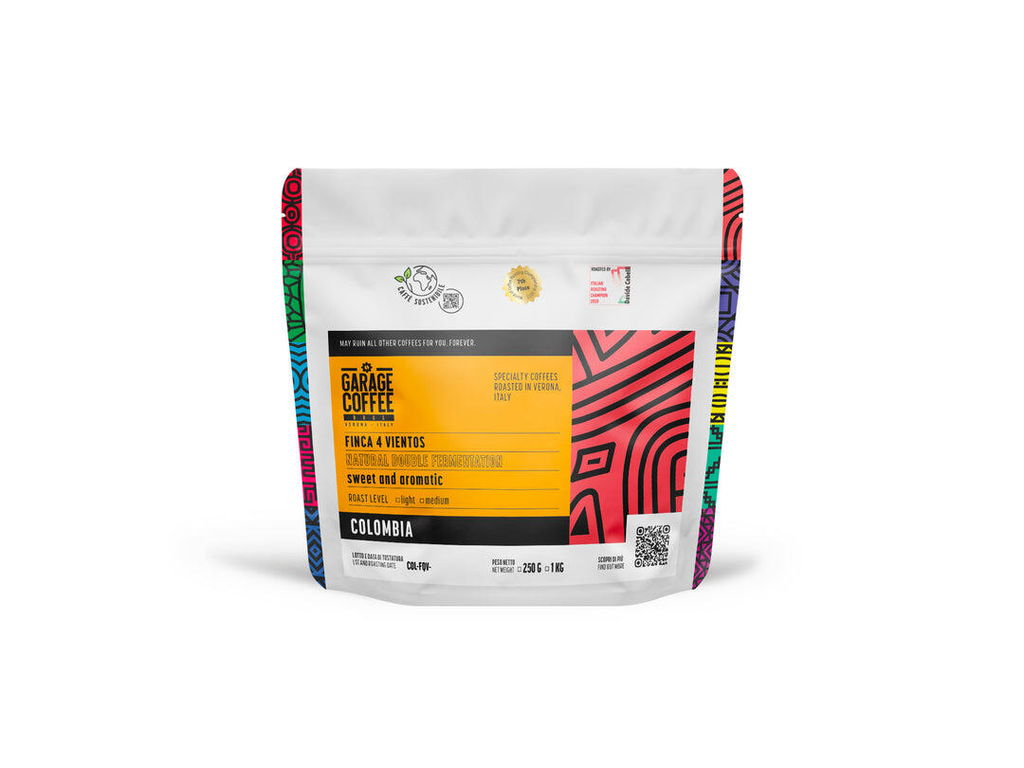
Specialty Coffee Colombia Estate 4 Winds Double Natural Fermentation
Tax included
Shipping calculated at checkout
🔥 Freshly roasted
Out of stock

From the heights of Pitalito, in the heart of Huila, comes a coffee that is much more than just a beverage: it is the story of a vision. The Finca 4 Vientos, located at 1,750 meters, is today led by the passion of Karenth Cerquera Chavarro, a young producer and certified SCAA taster. This microlot represents the new generation of Colombian coffee, where technical expertise meets deep respect for the land.
The sensory profile is sweet and fragrant, characterized by an explosion of red fruits and strawberries, accompanied by delicate hints of yellow fruits. Thanks to the meticulous process of double natural fermentation, the coffee develops a medium acidity perfectly balanced and a medium and silky body. Each cup stands out for its cleanliness and an aromatic persistence that invites a second sip.
The producer's touch: This coffee undergoes a 24-hour anaerobic fermentation in sealed bags, followed by 24 hours of oxidation and a slow 15-day sun drying. The result? An extraordinary aromatic complexity.
FARMGATE PRICE
FARMGATE PRICE: €8.79 (paid directly to the farmer)
The Farmgate price is ultimately the actual price paid to the farmer who produced the coffee at origin. It is, in fact, the most transparent price you can find.
To the Farmgate price, the following costs must be added before reaching the roastery:
- Packaging costs
- Handling costs at origin
- Logistics costs (shipping and customs duties)
- Handling costs upon arrival
- Customs clearance and phytosanitary inspection costs in Europe
- Internal transport costs
SENSORY DESCRIPTION
TECHNICAL DESCRIPTION
| Origin | Colombia |
| Area | Huila |
| Cooperative/Farm | Karenth Chavarro |
| Microlot | Finca 4 Vientos |
| Altitude | 1750m |
| Variety | Caturra |
| Process | Double Natural Fermentation |
FULL DESCRIPTION
Located in the village of La Meseta in Pitalito, Huila, at an altitude of 1,750 meters above sea level, Finca 4 Vientos is a place where tradition and quality coffee meet.
With about 5 hectares dedicated to cultivation, this family-run farm has been producing coffee for over 20 years: a legacy rooted in love for the land and deep respect for every single bean.
Today, that legacy is in the hands of Karenth Cerquera Chavarro, a 23-year-old producer, certified barista technician, and cupper with SCAA specialization. As a proud representative of the new generation of Colombian coffee growers, Karenth brings a fresh perspective that blends technical expertise, sensory passion, and an unwavering commitment to her roots.
At Finca 4 Vientos, they don’t just grow high-altitude coffee: they cultivate dreams to share in every cup, carrying with them the spirit of Huila and the energy of the wind that gives this farm its name.
💧 Processing and Quality
The processing begins with the conversion of the cherry into parchment coffee at an eco-friendly wet processing plant, designed to minimize water usage. The plant is equipped to handle washed coffees – both fermented and non-fermented – as well as semi-washed styles. Drying takes place in greenhouses and under shaded polyethylene structures to ensure slow and even dehydration that promotes product safety, longer shelf life, and reliable traceability. The estate also houses the equipment and machinery necessary to grind and prepare the coffee according to export-ready specifications, ensuring end-to-end quality control and full traceability within the family facilities.
-
Cherry Selection: It begins with the manual harvesting of cherries at their peak ripeness.
-
Flotation: The flotation phase is performed to remove unripe or defective cherries.
-
Fermentation and Oxidation: The coffee undergoes 24 hours of fermentation in sealed bags (anaerobic), followed by 24 hours of oxidation in traditional cement tanks.
-
Drying: The coffee is dried for 15 days inside a solar dryer.
🌱 Social and Environmental Commitment
Finca Los Papales is certified by the Rainforest Alliance, supporting alignment with international standards and the requirements of the Sustainable Agriculture Network. The farm also maintains a strong social commitment to its community. An on-site school serves about 65 children from early childhood through sixth grade, offering free education to employees' children and those from nearby communities, along with school supplies, daily meals, and participation in special activities such as Children's Day, Mother's Day, and graduation ceremonies. Educational supervision is provided by the Ministry of Education of Nicaragua (MINED). A health center on the farm, supervised by the Ministry of Health (MINSA), offers free consultations for employees and local residents, including immunization services for children, gynecological care for women, and general medical attention.
🔬 Lot Processing Profile
The coffee is harvested with 94% fully ripe cherries. The whole cherries undergo anaerobic fermentation for three days, after which the coffee is pulped and fermented again, in the mucilage, for another three days. It is then traditionally washed with clean water and dried on African raised beds for 12-16 days to reach about 11% moisture content. The coffee is stored in parchment for a minimum of 21 days before final processing.
Nitrogen & vacuum sealing
Roast profile
- Light — great for V60/Aeropress, for those who want brighter acidity and lots of aromatics. Recommended for all pressure-free methods (filter, Aeropress and similar).
- Medium — great for espresso/Moka, for those who want a more intense flavour with a hint of bitterness. Recommended for espresso and Moka.
Grind
Shelf life
Compostable packaging eco
Espresso
- Fine grind
- Water at about 90–92°
- Single dose 8–9 g (double 15–17 g)
- Extraction around 25 seconds
Moka
- Filtered or bottled water (never tap)
- Medium-fine grind, don't tamp
- Medium heat; take it off the stove as soon as the flow turns pale
Filter V60 / Chemex
- Medium grind (medium-coarse for Chemex)
- About 15 g per 250 g of water, at 90–94°
- Bloom 30–40 s, total draw-down ~3 min
Aeropress
- Medium grind, water at 85–90°
- About 17 g per 200–220 g of water
- Bloom 30–40 s, total time 2–3 min
Other methods